Client Workflow Optimization
UX and digital operations improvements across client-facing and internal systems in a compliance-driven tax and accounting environment.
Clarity
cleaner client-facing steps and handoff expectations
SOPs
structured documentation for repeatable operational quality
Audits
recurring usability review across internal systems
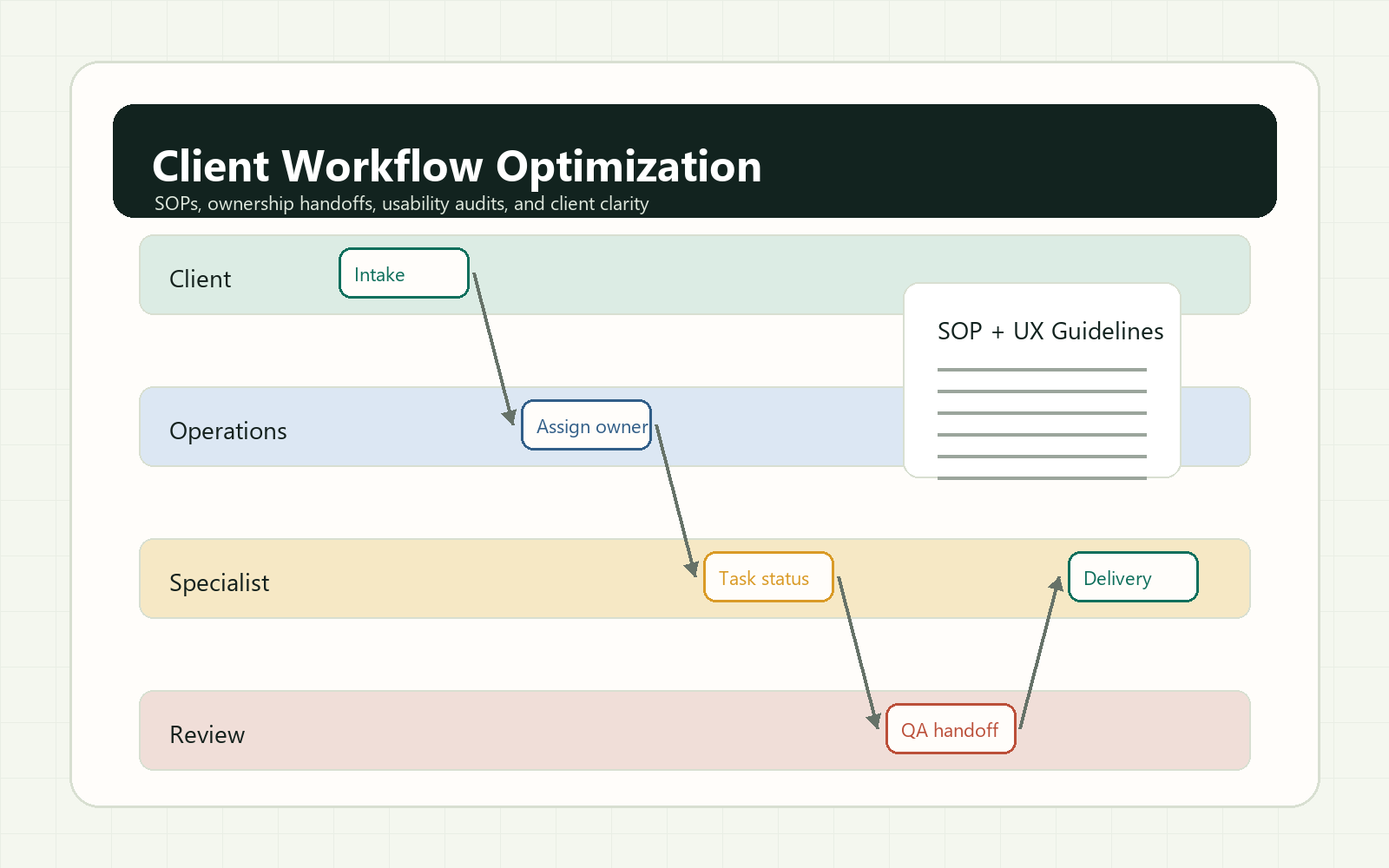
Operations work became part of the UX system: client clarity, ownership handoffs, status visibility, QA, and delivery expectations.
Outcome summary
Improved workflow consistency by clarifying client-facing steps, ownership handoffs, SOPs, UX guidelines, and recurring usability issues across high-volume tax and bookkeeping operations.
Project Overview: Clarifying Client And Internal Workflows
At IntegraVest, I work on UX and digital operations across client-facing and internal systems in a compliance-driven tax and accounting environment. The focus is on making workflows clearer, more consistent, and easier for both clients and staff to follow.
Challenge Identification: Fragmented Task Flows
Client and internal workflows can become fragmented when responsibilities, status changes, documentation, and handoffs are unclear. These gaps increase the risk of delays, drop-offs, repeated questions, and inconsistent service delivery.
User Insights: Understanding Client And Team Needs
The work requires attention to both sides of the experience: clients who need clear next steps and internal teams who need reliable process visibility. Recurring usability audits help identify where clarity breaks down.
Role and Contributions: Defining My Impact
As a Senior UX and Digital Operations Specialist, I restructure task flows, clarify ownership handoffs, document SOPs, create UX guidelines, and support high-volume operational workflows while improving system usability.
Constraints and Considerations: Designing For Compliance And Throughput
Tax and accounting operations require accuracy, privacy, deadlines, and process consistency. Improvements need to support speed without creating ambiguity or operational risk.
Solution: Workflow Design Beyond The Interface
I improved the experience by aligning interface clarity, documentation, process ownership, and team expectations. This made the work easier to repeat and easier to explain, especially during high-volume periods.
- Clarified task flows and ownership handoffs.
- Developed SOPs, UX guidelines, and workflow documentation.
- Conducted recurring usability audits across client and internal systems.
Conclusion: UX Includes The System Around The Screen
This work reflects my belief that UX is not limited to interface design. The best experience often comes from aligning screens, processes, documentation, team behavior, and client expectations.